(How It) Works Wednesday: Architectural Adaptation
(How it) Works Wednesday: Architectural Adaptation
9-11 is by far the
most impactful international event I've experienced in my
lifetime.
The events of 9-11 serve as an unpleasant memory I do not wish to explore. Rather, as this is (How It) Works Wednesday, I want to explore a subject I find as fascinating as it is misunderstood: The mechanics of towers’ collapse itself.
I find that in the rush of attention to human stories, we often forget the way our physical environments, including our built environments, shape those stories. From the international political drama to individual heroism and tragedy, most coverage of 9/11 focused on the human.
However, the towers themselves shaped the way the human stories played out.
For instance, what would've happened had those towers stood for longer? Or, perhaps, indefinitely? What if something about their construction and design permitted more people to evacuate?
The events of 9-11 serve as an unpleasant memory I do not wish to explore. Rather, as this is (How It) Works Wednesday, I want to explore a subject I find as fascinating as it is misunderstood: The mechanics of towers’ collapse itself.
I find that in the rush of attention to human stories, we often forget the way our physical environments, including our built environments, shape those stories. From the international political drama to individual heroism and tragedy, most coverage of 9/11 focused on the human.
However, the towers themselves shaped the way the human stories played out.
For instance, what would've happened had those towers stood for longer? Or, perhaps, indefinitely? What if something about their construction and design permitted more people to evacuate?
Learning to explore
answers to such questions has a real bearing on the here and now.
Traumatic events will continue to stress human habitats, from
individual buildings to entire cities. Understanding the role these
components play in catastrophic events will help us make changes to
mitigate future ones.
So for this blog post, I will explore how the construction of the towers themselves contributed to the collapses. Then, I will look at how the architects constructed the new WTC tower, as a case study for architectural adaptation in response to stress.
So for this blog post, I will explore how the construction of the towers themselves contributed to the collapses. Then, I will look at how the architects constructed the new WTC tower, as a case study for architectural adaptation in response to stress.
note: I use official NIST data and explanations to describe the collapse. There are interesting alternative theories that postulate everything from explosives to thermite as the cause of the collapse. These are highly unlikely to be true, with little supporting evidence (see this article here) and given that, I won’t spend any time exploring them.
WTC Construction
Minoru
Yamaski, the Japanese-American architect responsible for the
construction of WTC, grew
up on the Pacific coast in the early 1900’s.
Despite severe discrimination, herose
to become one of the 20th
century’s premier architects. At his passing, his
designs marked the
skylines of several cities, with prominent skyscrapers in Tulsa,
Detroit, Seattle, Buffalo, Los Angeles and Richmond in his legacy
Foremost among these was the World Trade Center.

Yamaski’s
was a monumental task. To
construct his huge buildings, he relied
upon an innovation called
the “framed
tube structure,” a
giant, stiff hollow tube
made using
a lightweight steel frame, connected
by floors made
from plates and trusses.
This design
permits most of the interior to be column-free, maximizing available
floor space, and has been
used for every supertall skyscraper since.
This innovative design
also proved to be the towers’ undoing decades later.
The collapse
The jetliners impacted the buildings at 465 and 590 mph for the north
and south tower respectively. The impacts exploded jet fuel over
several floors, igniting carpets, paper, electronics, and furnishings
etc which continued to burn long after the jet fuel had been
consumed.
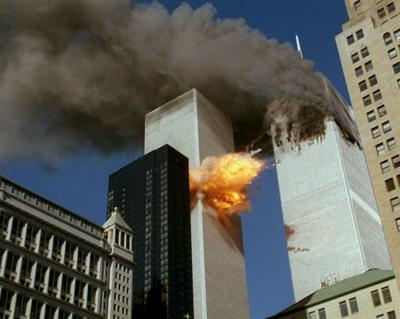 |
| South Tower just after impact. The explosion exiting the building came from the plane impacting the opposite side of the building, indicating that the force and velocity of the impact traveled all the way through the building's floors. |
The impacting planes penetrated all the way through the buildings and
out the other side, severing numerous perimeter columns and
demolishing entire floors of impact. The subsequent fires, burning at
nearly 1000 degrees C, softened the steel in the frames, causing it
to lose strength. Eventually, the weakening columns failed,
transferring their weight loads to other columns that then also
failed. Eventually, the damaged floors fell onto the undamaged floors
below. The towers’ uncompromised steel structure could bear
enormous stationary loads, but the moving loads proved way too much,
with the impact of the collapsing floors shattered each floor in
succession. This rare and devastating process of structural failure,
where is called progressive collapse.
Thousands died in both towers. In the north tower, no one above the
floors of impact survived. In the south tower, only four did. The
lightweight construction included a purely steel core protected by
lightweight drywall panels, which allowed the impacts to destroy the
elevators and sever most of the stairwells.
In addition, those who did escape faced hellacious conditions, with thousands descending at agonizingly slow paces through narrow stairways full of smoke, dripping with water and jet fuel, and dark from cut electricity.
In addition, those who did escape faced hellacious conditions, with thousands descending at agonizingly slow paces through narrow stairways full of smoke, dripping with water and jet fuel, and dark from cut electricity.
Learning from it
The new WTC has unique security features adapted from this
event.
First and foremost, it rises from a bombproof concrete pedestal, with a reinforced concrete core extending all the way to the top of the building. As opposed to regular concrete which can withstand forces of 3000-6000 PSI, the specially reinforced concrete in the WTC tower can withstand up to 12000 PSI. With these in place, the buildings are especially resistant to the progressive collapse seen in the original trade center.
Within this concrete core are several extra-wide stairwells, including one specifically for firefighters to use, as well as reinforced elevator shafts, including another specifically for firefighters. The stairwells are wider than they were in the original WTC, and they are also pressurized, with chemical and biological filters to prevent contamination in the case of an emergency.
First and foremost, it rises from a bombproof concrete pedestal, with a reinforced concrete core extending all the way to the top of the building. As opposed to regular concrete which can withstand forces of 3000-6000 PSI, the specially reinforced concrete in the WTC tower can withstand up to 12000 PSI. With these in place, the buildings are especially resistant to the progressive collapse seen in the original trade center.
Within this concrete core are several extra-wide stairwells, including one specifically for firefighters to use, as well as reinforced elevator shafts, including another specifically for firefighters. The stairwells are wider than they were in the original WTC, and they are also pressurized, with chemical and biological filters to prevent contamination in the case of an emergency.
The building is also 65 feet away from the street, rather than the
original towers’ 25 feet, with blast-resistant plastic on the lower
street-facing floors rather than glass. The tower also rises from a
130 foot-tall podium made from the same blast resistant concrete as
the core, protecting it from any car garage or street bombings like
the one that affected the towers in 1993.
 |
| New WTC 1's concrete podium. |
Conclusion
We are kidding ourselves if we think traumatic events will not
continue. Whether natural or manmade, disasters will continue to
affect our cities and communities.
If we can learn from these events and invest necessary expense towards forward-thinking adaptation, the impact of these disasters can be mitigated.


Comments
Post a Comment